

Stackable Washer and Dryer: The Complete 2026 Buying Guide
Condo, laundry closet, bathroom or narrow basement: when space is tight, a stackable washer and dryer is the answer. By stacking the dryer on top of the washer, you free up half the floor space without giving up a real laundry room.
But not every washer can be stacked, and a poorly planned installation can quickly become a headache. Dimensions, clearances, stacking kit, vented or ventless dryer… This Corbeil Appliances guide covers everything you need to check before you buy.
1. 3 ways to get a vertical laundry setup
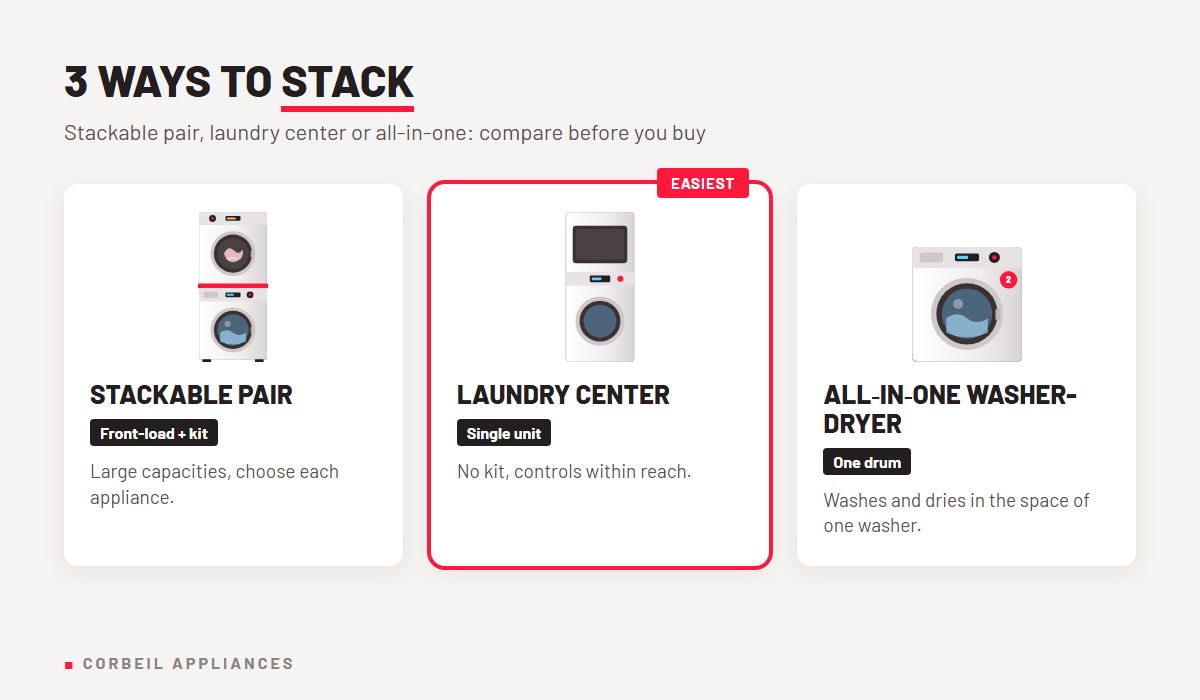
When people say "stackable washer and dryer", they actually mean three different types of appliances:
| Type | How it works | Best for |
|---|---|---|
| Stackable pair | A front-load washer and a dryer sold separately, stacked with a stacking kit. | People who want large capacities and the freedom to choose each appliance. |
| Laundry center | A single unit: washer on the bottom, dryer on top, with controls grouped together. | Closets and condos: simple installation, no kit needed. |
| All-in-one washer-dryer | One drum that washes, then dries, with nothing to stack. | Very small spaces where even a column won't fit. |
Want to compare all-in-one models? Browse our all-in-one washer-dryer combos.
2. Measure your space: 24 or 27 inches?
Width determines everything else: capacity, the type of kit and where the appliance can go.
| Size | Washer capacity | Stacked height (approx.) | Best for |
|---|---|---|---|
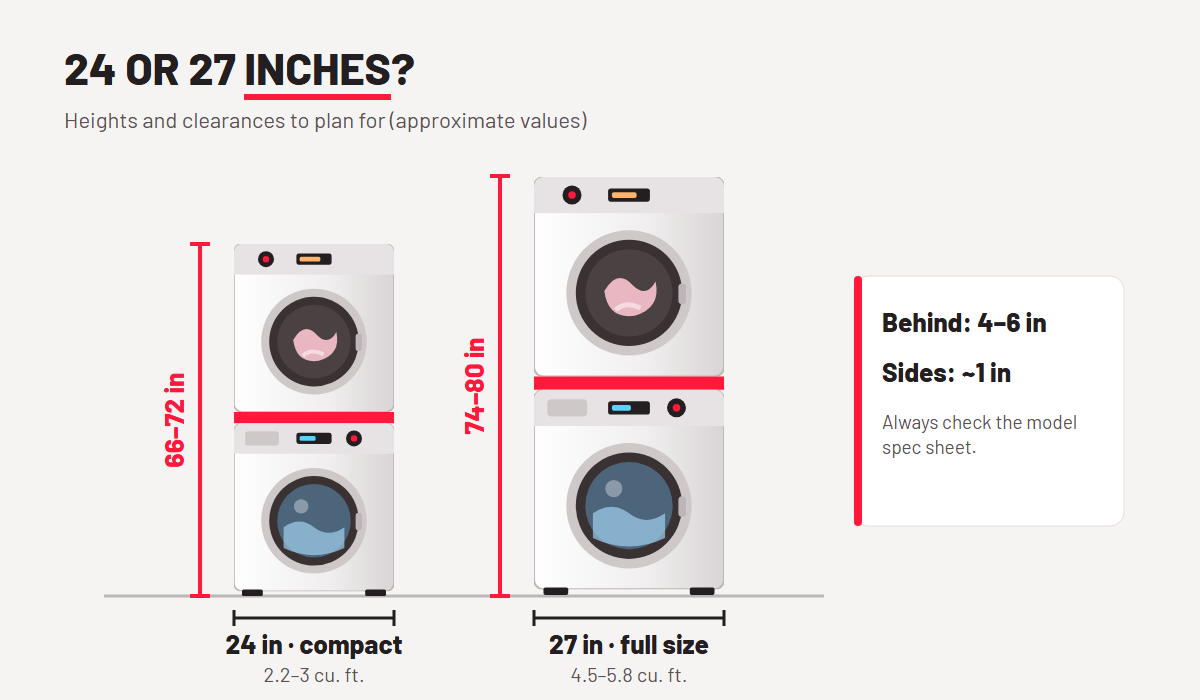
| 24 in (compact) | 2.2 to 3 cu. ft. | 66 to 72 in | Condo, bathroom, narrow closet, 1 or 2 people |
| 27 in (full size) | 4.5 to 5.8 cu. ft. | 74 to 80 in | Families, closet or basement laundry room |
Heights vary by model: always check the spec sheet. Also measure door frames and stairways to make sure the appliances will fit through.
Clearances to plan for
- Behind: about 4 to 6 in for the dryer vent, hoses and electrical connection.
- On the sides: about 1 in for airflow and installation.
- Above: a few inches so you can slide the unit in and reach the connections.
- In front: enough room to fully open the doors and load laundry.
- In a closet: use a louvered door or add ventilation openings at the top and bottom.
3. 6 things to check before you buy
A front-load washer is a must
To stack two separate appliances, you need a front-load washer. A top-load washer can't hold a dryer on top. The only exception is a laundry center, which is designed as a single unit from the start.
A compatible stacking kit
The kit secures the dryer to the washer and keeps it from shifting during the spin cycle. It must be compatible with both models, which usually means the same brand. Some kits even include a pull-out shelf for folding. We carry Bosch, Whirlpool, GE kits and more in our laundry accessories.
Vented or ventless dryer?
- Vented dryer: exhausts hot air outside through a duct. The most common option if your laundry area already has an exhaust outlet.
- Ventless dryer (condensation or heat pump): no duct to the outside. Ideal in a condo or an interior apartment, and heat pump models use significantly less energy.
Electrical requirements
A full-size electric dryer usually requires a 240 V outlet. Some compact models run on 120 V. Check your setup before you buy to avoid surprises on delivery day.
Floor and vibration
A stacked washer-dryer is tall and heavy: install it on a solid, level floor and adjust the feet. On an upper floor or above a finished room, a drain pan under the washer is good protection.
Easy-to-reach controls
In a stacked setup, the dryer controls end up high. If several people will use it, look for a model with controls that are easy to reach, like laundry centers with a central control panel.
Our popular stackable washers and dryers
4. Stackable pair or laundry center?
| Stackable pair | Laundry center | |
|---|---|---|
| Capacity | Large, up to about 5.8 cu. ft. | Medium to large depending on the model |
| Installation | Stacking kit required | Ready to install, no kit |
| Flexibility | Can go side by side later | Single unit |
| Controls | Dryer controls up high | Often grouped at eye level |
| Examples at Corbeil | LG, Samsung, Bosch, Electrolux | LG WashTower, GE, Whirlpool, Electrolux |
Discover all our laundry centers, including LG WashTower, GE, Whirlpool and Electrolux models, in 24 and 27 in sizes.
5. Caring for a stackable washer and dryer
- After every load: clean the dryer lint filter.
- Monthly: run the front-load washer's cleaning cycle and leave the door ajar to prevent odours.
- Twice a year: make sure the stacking kit is tight and the column is level.
- Yearly: clean the exhaust duct (vented dryer) or the condenser (ventless dryer).
Frequently asked questions
Can you stack any washer and dryer?
No. You need a front-load washer and a compatible dryer, usually of the same brand and width, with the stacking kit recommended by the manufacturer.
How tall is a stacked washer and dryer?
About 66 to 72 in for a compact 24 in pair, and about 74 to 80 in for a full-size 27 in pair. The exact height depends on the model: check the spec sheet.
Do I need a stacking kit?
Yes for a separate washer and dryer: the kit secures the dryer and keeps it from shifting during the spin cycle. A laundry center doesn't need one, since it's designed as a single unit.
Which dryer is best for a condo with no exhaust vent?
A ventless dryer, either condensation or heat pump. It needs no duct to the outside, and heat pump models use much less energy.
Stackable or all-in-one washer-dryer: which should I choose?
A stacked pair offers larger capacities and lets you wash one load while another dries. An all-in-one takes the space of a single washer, but a full wash-and-dry cycle takes longer. If you have the height, a stacked setup is usually more practical for a family.
Need advice? Our in-store experts can help you choose the stackable washer and dryer that fits your space.