

Wine Fridge Buying Guide: How to Choose the Right Wine Cellar in 2026
Good wine deserves better than the kitchen counter or the back of the fridge. A wine fridge keeps your bottles at the right temperature, away from light and vibration, and ready to serve when guests arrive. The trick is choosing the right one: capacity, temperature zones, built-in or freestanding… there are plenty of options.
At Corbeil Appliances, we carry more than a hundred wine cellars and coolers, from compact 15-inch models to large long-term storage cellars, from brands like Aviva, Whirlpool, Frigidaire, GE Café and Asko. Here's how to find the right one for you.
1. Why a wine fridge instead of your refrigerator?
A regular refrigerator is too cold (around 4 °C), too dry, and frequent door openings cause temperature swings. Over time, corks dry out and wine loses its aromas. A wine fridge gives you:
- Stable temperature, set for your wines;
- Proper humidity to keep corks in good condition;
- UV protection thanks to treated glass doors;
- Low vibration, so the wine rests undisturbed;
- Racks designed for bottles, stored horizontally to keep corks moist.
2. Storage cellar, serving cooler or beverage center?
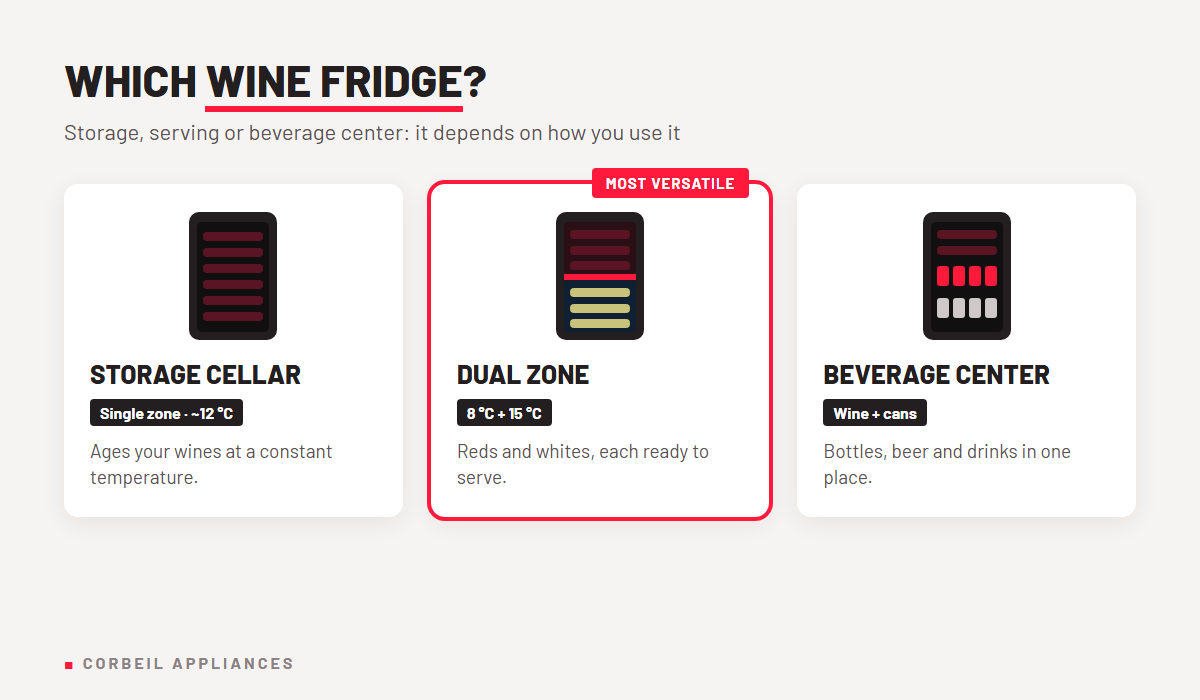
Before comparing models, ask yourself: do you want to age your wines or have them ready to drink?
| Type | What it does | Best for |
|---|---|---|
| Storage cellar (single zone) | Keeps all wines at a constant temperature of about 12 °C for slow aging. | Collectors who keep bottles for years. |
| Serving cooler (dual zone) | Two separately controlled compartments: one for reds, one for whites and sparkling. | People who drink their wines within months and entertain often. |
| Beverage center | A mix of bottles and cans (beer, soft drinks, sparkling water). | The basement bar, family kitchen or games room. |
For most households, a dual zone wine fridge is the most versatile: it keeps reds and whites, each at its serving temperature. Want room for beer and cold drinks too? See our beverage centers.
3. 6 things to consider when choosing a wine fridge
Capacity: plan bigger
Capacity is listed in standard Bordeaux bottles (750 ml). Wider Burgundy or Champagne bottles reduce the real capacity. Simple rule: plan for at least 25% more than the number of bottles you have today, because collections grow fast.
| Width | Typical capacity | Best for |
|---|---|---|
| 15 in | 20 to 35 bottles | Under the counter, small kitchens, condos |
| 18 in | 30 to 70 bottles | Kitchen island, bar |
| 24 in | 40 to 60 bottles | The most popular size, under counter or freestanding |
| 24 to 30 in column | 150 bottles and up | Collectors, basement cellar |
Number of temperature zones
A single zone wine fridge is perfect for long-term storage. A dual zone wine fridge lets you serve reds and whites at the right temperature at the same time. Some large models even offer three zones.
Built-in or freestanding
This is the most often overlooked criterion, and the most important for installation:
- Built-in wine fridge: vents at the front, below the door. It can go under the counter or between cabinets with no side clearance.
- Freestanding wine fridge: vents at the back or sides and needs space around it. Never build it in: it would overheat and wear out prematurely.
- Panel-ready door: some built-in models accept a custom panel that matches your cabinets for a fully integrated look.
Cooling system
Most wine fridges use a compressor, which is efficient and reliable even in a warm room. Thermoelectric models are quieter with less vibration and suit small capacities in a temperate room, but they struggle when the room gets warm.
Racks and door
Look for sliding racks (ideally wood or wood-trimmed), a UV-protected glass door, LED lighting that doesn't add heat, a reversible door and, if you have kids or valuable bottles, a lock.
Noise and location
If the wine fridge goes in the kitchen or living room, check the noise level. Avoid placing it near a heat source (oven, baseboard heater, sunny window) or on an uneven floor.
4. The right temperature for each wine
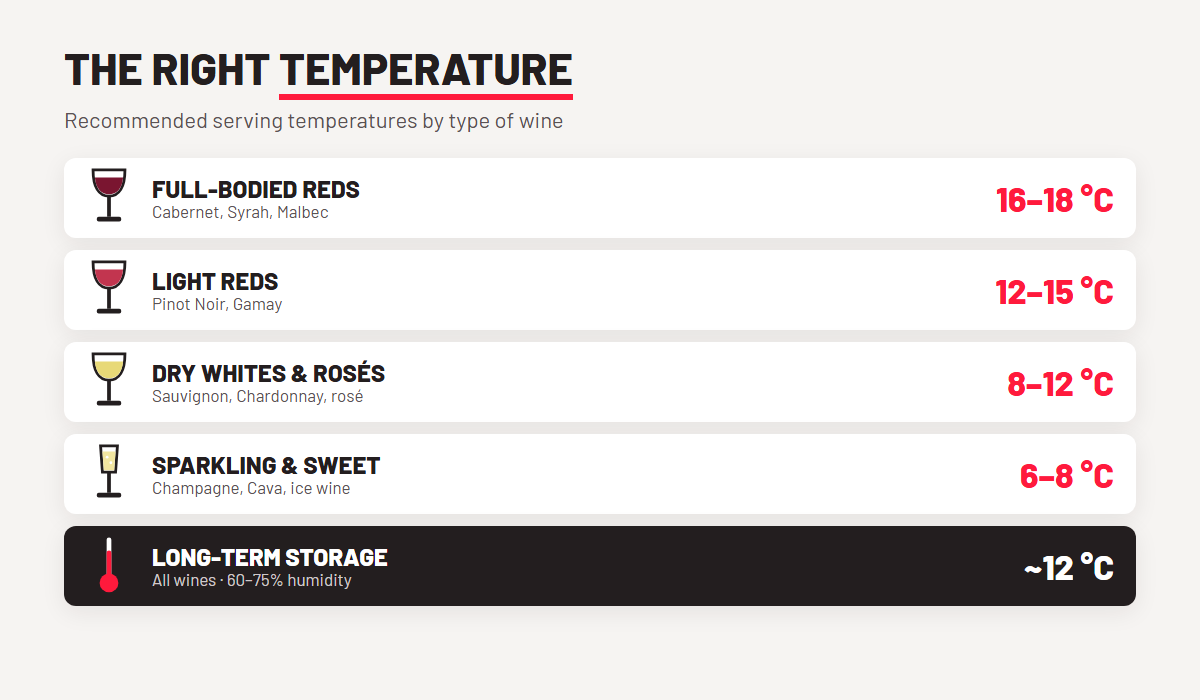
For storage, all wines keep well at around 12 °C, with 60 to 75% humidity. For serving, each wine has its ideal temperature:
| Type of wine | Serving temperature |
|---|---|
| Full-bodied reds (Cabernet, Syrah) | 16 to 18 °C |
| Light reds (Pinot Noir, Gamay) | 12 to 15 °C |
| Dry whites and rosés | 8 to 12 °C |
| Sweet whites, sparkling and Champagne | 6 to 8 °C |
With a dual zone wine fridge, set one zone around 15 °C for reds and the other around 8 °C for whites and bubbly.
Our popular wine fridges
5. Which wine fridge fits your budget?
| Range | What you get | Examples at Corbeil |
|---|---|---|
| Compact and affordable | 15 to 24 in, single or dual zone, great under the counter. | Aviva, Whirlpool, Frigidaire |
| Mid-range | Dual zone, sliding racks, stainless finish, LED lighting. | Frigidaire Gallery, GE, Aviva |
| High end and integrated | Premium design, panel-ready doors, large capacities. | GE Café, JennAir, Bertazzoni, Asko |
Good to know: several Aviva models are designed in Canada.
6. Caring for your wine fridge
- Twice a year: clean the interior with warm water and baking soda (avoid scented products), and dust the ventilation grille.
- Check the door gasket: a worn seal lets warm air in and makes the compressor work harder.
- Don't overload the racks: air needs to circulate between bottles.
7. A perfect holiday gift
A wine fridge is a favourite gift for wine lovers, and a real asset when entertaining over the holidays: bottles are ready to serve and the refrigerator stays free for food. Check out our promotions to find the right model at the right price.
Frequently asked questions
What's the difference between a wine cellar and a wine cooler?
The terms are often used interchangeably. Generally, a "wine cellar" is designed to store and age wine, while a "wine cooler" keeps it at serving temperature. Many dual zone models do both.
What temperature should a wine fridge be set at?
For long-term storage, about 12 °C for all wines. For serving, 12 to 18 °C for reds depending on their body, 8 to 12 °C for whites and rosés, and 6 to 8 °C for sparkling wines.
Can you build in a freestanding wine fridge?
No. A freestanding wine fridge releases heat from the back or sides and needs space around it. For under-counter installation, choose a built-in model with front ventilation.
How many bottles do I need?
Count your current bottles and add at least 25%. Remember that listed capacity is based on Bordeaux bottles: wider bottles take up more room.
Is a dual zone wine fridge worth it?
Yes, if you drink both red and white wine. Each zone is controlled separately, so every wine is ready at its ideal serving temperature.
Need advice? Our in-store experts can help you choose the wine fridge that suits your collection and your space.